
Sunday, June 28, 2026
Home Blog Page 501

Virtual Therapy: Helping Ease College Students’ Anxiety About COVID-19

0

By Kimberlee Bongard, NJ Spotlight

This story was written and produced by NJ Spotlight. It is being republished under a special NJ News Commons content-sharing agreement related to COVID-19 coverage. To read more, visit njspotlight.com

With the COVID-19 pandemic, the anxieties college students often experience trying to balance studies, jobs and social life can become almost overwhelming. Those anxieties can be further exacerbated at the end of the semester as they study for final exams and begin searching for jobs.

According to a 2018 study by Harvard Medical School of more than 67,000 college students at over 100 institutions, one in four reported being diagnosed with or treated for a mental health disorder in the prior year. One-fifth of all students surveyed had thought about suicide.

While stress is a regular part of college life for many students, a new study by BestColleges reports that out of 745 college students, 81% reported they were experiencing increased stress due to the pandemic and its impact on society. The study found that new stressors include how the coronavirus outbreak has interfered with their housing, travel, jobs, and income — at either the student or the household level.

The stress of social distancing
Further, colleges have had to close campuses and move to online instruction in compliance with social-distancing orders. But as BestColleges found, more than a third of respondents said campus closures and changing to online instruction increased their anxiety.

To help college students cope with this pandemic-related stress, colleges are making mental health counseling a priority by having college psychologists provide virtual counseling through phone and video appointments.

“In some ways, they’re in our homes and we’re in their homes and the boundaries are a little different, but the content feels the same,” said Nancy Friedman, a staff psychologist at Montclair State University’s Counseling and Psychological Services (CAPS).

Friedman gives one-on-one consultations with students in virtual sessions called “Let’s TeleTalk” and leads group therapy sessions via Zoom. The issues that surface during her virtual sessions range from typical issues for college students to more serious concerns related to COVID-19.

According to Friedman, students are worried about their family’s finances, their health and the health of relatives who are at greater risk of contracting the coronavirus. She said students who are still working or have relatives who are essential workers may feel particularly concerned about their health.

“People are really concerned about what their future holds — ‘When will this end?’ The uncertainty surrounding this is really challenging for students,” Friedman said.

How anxieties add up
Annmarie Wacha-Montes, assistant director for Community-Based Services, Counseling, Alcohol & Other Drug Assistance and Psychiatric Services (CAPS) for Rutgers Student Health, said students who struggled with anxiety prior to the pandemic now must manage their personal stress in addition to anxieties about the health crisis.

“Anxiety is typically the primary issue for undergraduate and graduate students seeking CAPS at Rutgers and nationally, but the anxiety is now also connected to adjusting to COVID-19,” Wacha-Montes said in an email. “Students share anxiety related to medical concerns for themselves and others, social isolation, uncertainty/‘the unknown,’ a lack of stability/structure, and financial stressors for themselves and family.”

While certain students may prefer virtual sessions, Friedman said finding a private space for a therapy session can be challenging for some students while they are living at home.

“They don’t feel as able to express themselves without fear of being overheard,” Friedman said. “Some students live in families where their being in therapy is not supported, so that can feel really difficult for some.”

To lead virtual sessions, counselors also had to designate spaces in their homes to conduct sessions privately to maintain students’ confidentiality. Other complications of virtual sessions are technical issues that can disrupt sessions and that students lack the necessary technology to participate in virtual sessions.

Technology gap for therapy
“Not all students have access to computers, good Wi-Fi connection or good phone reception. Rutgers has been assisting students with connecting to resources, such as providing laptops through the Dean of Students’ office, but Wi-Fi/phone connection is still an ongoing issue,” Wacha-Montes said.

Several students who volunteer at Active Minds, non-profit organizations that raise mental health awareness at colleges, said virtual counseling sessions can help students manage stress during this time.

Divya Daripalli, president of the Active Minds chapter at Rutgers University, said following the announcement about remote instruction, students were concerned whether they would still be able to meet with their counselors at CAPS.

“We’ve been trying to let people know the resources are out there and how they can help themselves through this time,” Daripalli said. “It’s good they’re offering (virtual sessions), because it can be very jarring to consistently meet with a therapist or a counselor and then suddenly not be able to.”

Students said that meeting with counselors virtually may help maintain their mental health while they are self-quarantined from family and friends who would usually provide support for them.

“Being in these social distancing circumstances can be very isolating for all people and more so for people with mental health issues,” said Victoria Cipparulo, the public relations chair of the Active Minds chapter at Montclair State University. “Some students, they’re able to do well with (social distancing) … I think other students have a real sensitivity to this — myself included, where losing that social aspect makes learning and engagement a lot more challenging.”

Cipparulo said without the routine of in-person classes and social events, virtual counseling can be a resourceful tool to help students work through difficult emotions and anxiety.

However, some students said the virtual setting deviates from the experience of speaking to a counselor in person.

“It’s an opportunity for students to talk to someone, but therapy isn’t traditionally over the phone, so it’s a learning curve for everyone,” said Larry Camarillo, the incoming president of the Active Minds chapter at Montclair State.

Daripalli said counselors may not be able to read students’ body language in video calls as easily as they would in person. She added that virtual sessions may not be suited for some students, particularly if talking over phone and video makes them anxious.

“I am very glad that they are offering the virtual sessions, but unfortunately I don’t think that it’s enough because there are benefits to teletherapy, but then there are also drawbacks,” Daripalli said.

State Deploys COVID-19 Saliva Test at Centers for Developmentally Disabled, Some Nursing Homes

0

By Lilo H. Stainton, NJ Spotlight

This story was written and produced by NJ Spotlight. It is being republished under a special NJ News Commons content-sharing agreement related to COVID-19 coverage. To read more, visit njspotlight.com

New Jersey plans to use a new, easier-to-administer COVID-19 test to screen residents and staff at state-run facilities for individuals with significant developmental disabilities and at nursing homes in South Jersey, strategy officials said could serve as a model for more widespread public testing as the state tries to recover from the coronavirus.

The initiative — the state’s first foray into large-scale institutional testing — will focus first on the 1,238 residents and roughly 4,300 employees at New Jersey’s five developmental centers; nearly 250 people living or working at these sites have been diagnosed with COVID-19, and seven residents have died of the disease.

State officials said they are also working with leaders at Cooper University Health Care, in Camden, to create a testing program for residents and staff at 16 long-term care facilities in the region; the goal is to use this screening to help contain the spread of the virus in a region that has so far been spared the worst of the outbreak. Across the state, nearly 13,800 positive COVID-19 tests have been connected to nursing homes and other residential care sites, and at least 1,540 deaths have been reported, with the worst impact at facilities in North Jersey.

Another 24,000 individuals with disabilities live at group homes in the community operated by state contractors; among this group, 221 have tested positive for the viral infection and 26 have died, according to the latest statistics. These facilities are not part of the initial saliva-testing program, but state officials said they intend to use this method to screen additional state workers and individuals in institutional care, so they could be among those on the list for this approach.

‘Prioritizing vulnerable populations’

“As we work to expand testing across the state, we will be prioritizing the most vulnerable populations like those who reside in these centers,” state Health Commissioner Judith Persichilli said. Residents in more crowded institutional settings, where it is hard to maintain social distance, are particularly at risk for becoming infected.

“Human Services is continuing to work 24/7 to support and protect individuals with developmental disabilities across our state,” said Human Services Commissioner Carole Johnson, whose department oversees programs for developmentally disabled residents. “The Department will continue to take all available actions to support our residents and staff.”

The state has faced a growing backlash for its efforts to control the spread in some public institutions, like veterans’ homes and prisons, where the virus has exploded in recent weeks. As of Monday, more than 500 corrections officials and inmates were infected and 16 prisoners had died. A plan to release certain nonviolent inmates has been slow to take effect after Gov. Phil Murphy announced it earlier this month.

Officials said the saliva test, unveiled by Rutgers University earlier this month, is already in use at multiple public screening sites, including the Federal Emergency Management Agency’s operation in Edison. Starting today, it will be also be offered at Robert Wood Johnson University Hospital in New Brunswick to screen all health care workers, whether or not they have symptoms; it is also being shared with other hospitals and health care networks, they said.

Murphy to discuss wider public use 

Murphy said he anticipates this type of testing will also be useful for wider public application, a process he promised to flesh out on Monday. “I have noted many times having a robust and greatly expanded testing program in place is vital to our being able to reopen responsibly our state,” the governor said at his press briefing Thursday. “I said it on Monday and I still believe it on Thursday that we need to at least roughly double our testing capacity’s minimal benchmark” to allow for a safe return to public life, he added.

New Jersey is now able to process tests for between 7,000 and 9,000 people daily between the public and commercial laboratories, according to state health officials; this number is impacted by the availability of test kits, swabs and other materials needed to administer the test, trained staff and the personal protective equipment (PPE) — gowns, masks and other health care gear — needed to keep them safe. Overall, nearly 100,000 residents have been diagnosed with the virus, including more than 5,300 who have died.

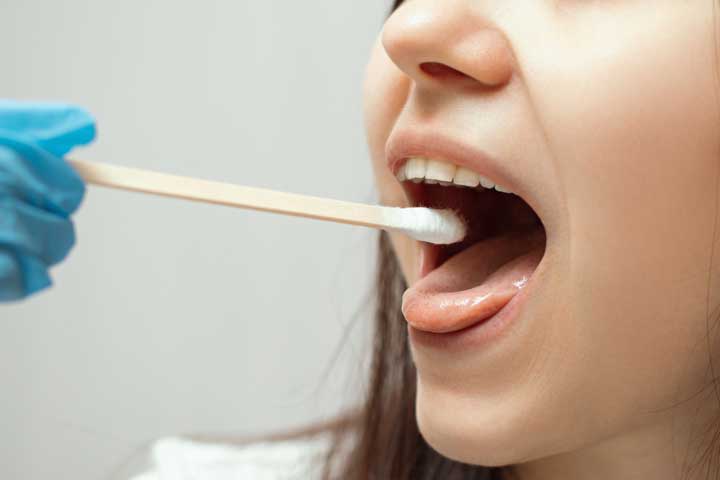
Dr. Brian Strom, chancellor of Rutgers University Biomedical and Health Sciences  — an umbrella entity that oversees the program that developed the test in conjunction with a private lab — said the new method has the capacity to screen 10,000 people a day and could be scaled to two or three times that volume fairly easily; they are currently seeking the staff and other resources needed to make this expansion possible. The process includes collecting a small amount of saliva in a special tube, which he said is far easier, and less invasive, than the deep nasal and throat swabs needed for the traditional test. It also appears to be more accurate, according to a new review by Yale University, he said.

Collecting the saliva sample also involves far fewer clinicians than the previous tests, Strom noted, a benefit that reduces the need for PPE by 90% and doesn’t depend on swabs, which have been in short supply. An easier collection process also speeds the testing protocol, allowing four times as many people to be screened than under the swab system, he noted.

Strom said these characteristics make the saliva test ideal for widespread public use. Rutgers is now working with Newark Mayor Ras Baraka to design a program to screen at least 100,000 Brick City residents, he noted, and the university also plans to use the test to help assess the health of students and staff as it decides how to reopen classes.

Key for health care providers

The test will also be important for health care providers as they continue to respond to the current epidemic and plan for what’s next, Strom said. “As we begin to plan for the ability of the health care enterprise to begin to take care of non-COVID patients again we need to be sure we don’t give COVID to the patients we take care of,” he noted.

While Murphy has repeatedly cautioned against relaxing the strict social-distancing requirements instituted in late March, he has also hinted for weeks at the need to plan the state’s reopening, or re-entry, and coordinate the timeline with other states in the region. On Sunday, he appointed his chief of staff, George Helmy; Robert Wood Johnson Foundation President and CEO Dr. Richard Besser; and former U.S. Secretary of Homeland Security Jeh Johnson to a multistate council that will oversee this process.

Murphy has also stressed that reopening the state requires not just a robust testing program, but also the capacity to track down and warn all the potential contacts for someone who tests positive, and the ability to quarantine that person — providing shelter, food, medicine, and other services — for up to 14 days. Persichilli said she is finalizing a testing strategy required for a larger, statewide reopening, which she said would be available next week.

VLANJ Goes Virtual to Serve People With Vision Loss During COVID-19 Crisis

0

MORRIS COUNTY — When the COVID-19 pandemic forced Vision Loss Alliance of New Jersey to halt programs at its locations, that left a hole in the lives of people who are blind and visually impaired. VLANJ needed a temporary home for its Beyond Sight wellness classes, peer support groups, and an apps club, and found it through video conferencing.

“We wanted to give participants something to look forward to, and help everyone stay calm and connected,” said Linda Groszew, VLANJ’s senior program manager and volunteer coordinator. VLANJ is running Fit & Balance classes twice a week. Yoga, two support groups, and an Apps Club are offered weekly. Between nine and 14 people participate in each session using Zoom, Groszew said.

Bergen County resident Lori DeMarco has been taking advantage of the offerings. “Vision Loss Alliance is making the best of a bad situation,” said DeMarco, who’s attended VLANJ for 12 years. DeMarco, a retired teacher, lost her sight to diabetes when she was 26.

DeMarco said she especially appreciates the fitness classes. “I’m an active person, and I normally go to the gym three times a week, but I’m not motivated to work out at home alone,” she said.

Christina Brino teaches the Thursday Apps Club, assisted by VLANJ participant and technology instructor Susanne Sytsma. Each week, Brino and Sytsma introduce participants to new apps and encourage them to share with the group apps they’ve discovered.

“They seem to be getting a lot out of it,” said Brino, a former disabilities coordinator for the Morris County Department of Human Services who is blind since birth. The Apps Club is an extension of VLANJ’s iPhone and Ipad technology program, designed for people who’ve completed the mobile technology class.

With Zoom, people without computers can still participate by dialing in on either a smartphone or landline, Brino said. During instruction, participants’ devices are muted, but they are able to use a ‘raise your hand’ function to ask questions. Brino has taught them Zoom shortcuts, such as how to add events to their calendar, so they can simply click on a link to join.

Brino said she always leaves time at the end of class for participants to chat. “They miss each other, so it’s nice for everyone to hear each other and catch up,” she said. “It feels like we’re really there together.”

On a recent Tuesday, 14 people gathered on Zoom for an hour-long Meditation & Mindfulness session. Instructor Karen Noel led the group through breathing exercises, encouraging members to use the mind’s eye to focus on different parts of the body. The experience was deeply soothing. She addressed the COVID-19 crisis, saying, “We will get to the other side!”

The Tuesday meditation class at 1:30 p.m. EST is open to all with vision loss. There is no fee, but registration is required and the number of participants limited. Click here to register. Other fee-free classes are for VLANJ participants.

DeMarco said the fallout from COVID-19 “can be very depressing.” VLANJ’s virtual programs are helping her to stay positive. “It really connects us.”

For more information on VLANJ’s virtual programs, send an email to [email protected].

VLANJ is one of the state’s longest-serving nonprofits for adults with vision loss. Created in 1943, the nonprofit has evolved into the only comprehensive, nonresidential vision rehabilitation program for adults in New Jersey. It provides direct services in three counties to 225 adults, and another 1,000 participate in outreach programs.

Fashion Design Students at CCM Spearhead Face Mask Project

0
CCM Design Professor Anita Collins at her sewing machine while she works on making more face masks

MORRIS COUNTY — Helping healthcare and other workers during this time of crisis are six fashion design students, their professors, and several employees at County College of Morris (CCM) who are making face masks to protect those working on the front line during the COVID-19 pandemic.

Nieasia Wilkins, of Budd Lake, a student at CCM, working on making face masks for healthcare and other frontline workers

“What helping people in this way means to me is making an impact,” says Emil Desena, of Randolph, one of the students working on the project. “Even just on a small, local level, it’s still important, and I’m glad that I’m able to use my passion for sewing and creating in a way that helps others.”

The project began after faculty learned that some students had started making masks during the college’s spring break in March and as hospitals and other organizations started asking for personal protective equipment (PPE) for their employees.

“As the design faculty migrated to online classes we lost our ability to deliver coursework using our traditional hands-on teaching methods,” says Professor Kelly Whalen, who oversees the design programs at CCM. “Faculty and students shared research and information about acceptable mask designs that would be useful to a variety of facilities and individuals. A few videos, recommended by healthcare organizations and others, were selected, providing clear instructions on how to construct the masks. Faculty then chose to adopt the project in their Introduction to Sewing, Design Concepts I & II, and Fashion Construction II classes.”

Whalen is serving as coordinator of the face mask project, while Professors Anita Collins and Wendy Carmona are working closely with the students and making masks themselves. Several CCM staff members also have become involved in the project, making it a college-wide effort. 

CCM Masks Being Sent to Health Facilities Throughout the Community

To date the students and professors have made nearly 200 masks, including several child-sized masks that will be donated to a pediatric healthcare facility in the next few days. Masks have already been delivered to a hematology and oncology facility affiliated with Morristown Medical Center, as well as to Compassionate Care healthcare workers in Sparta.  Others that have received, or will be receiving masks soon, are Saint Clare’s Hospitals in Denville and Dover, Overlook Hospital, and workers at UPS.

“It’s real-world problem solving, as we have had to organize distributing fabric, sourcing elastic, identifying places in need and then getting the masks to where they are needed while adhering to the social distancing and disinfectant protocols,” says Whalen.

Students are either using fabric they have on hand or received at a recent equipment distribution event the college held for students, faculty, and staff earlier this month. Whalen has been receiving the finished masks via home mailboxes and trunk exchanges. Regarding delivery of the masks, they are given to people CCM students, faculty, and staff know at the facilities that are looking for PPE for their workers.

“I have shared with the students that their knowledge of sewing and design is an essential skill that impacts the world,” notes Collins. “As fashion designers, they are able to create wearable items that not just make people look and feel beautiful, but also protect them and help to save lives.”

Other students making face masks are Jenna Lentz, of Fairfield; Taylor Moss, of West Orange; Louis Smith, of Basking Ridge; and Nieasia Wilkins, of Budd Lake. CCM employees helping with the project include Rosemary Grant, Brian Kafel, and Jeri LaBruna and also Adjunct Professor Gregory Somjen.

“I feel very happy and humbled to know that something I love doing can help others stay safe,” says Devyn Orozco, of Lake Hiawatha, another student making masks. “I believe that every little bit counts, and together we can help stop the spread of the virus.”

Want to learn more about fashion design? Register now for summer and fall at CCM click here.

Boonton PBA / Fire Department Food Drive to be held

0
Boonton Town Hall

BOONTON — The Boonton PBA Local 212 and Boonton Fire Department Food Drive will be held at Boonton Town Hall from 9:00 a.m. to 12:00 Noon on Sunday, April 26. Please help us help others! Drive up-Drop off-Drive away, you don’t even have to get out of your car!

We will be staffing this event with minimal manpower in order to preserve our social distancing and conserve on the use of personal protective equipment.

They do understand that while many wish to contribute, not everyone may be passing by Town Hall off of Madison Street, Boonton on their way home from their local grocery store nor may they be comfortable leaving their homes to drop off food.

If you can’t make it please consider donating via the Boonton PBA 212 / Boonton Fire Department Gofundme link by clicking here.

Kiwanis Club of Greater Parsippany Feeds Guests at Homeless Solutions

0
Kiwanis Club of Greater Parsippany member Nicolas Limanov with Homeless Solutions Volunteer Manager, Tamala Reynolds

PARSIPPANY — Keeping with its 19-year tradition, Kiwanis Club of Greater Parsippany provided 60 individually packed hot meals prepared by IHOP Parsippany.

This month, due to the Coronavirus, instead of our volunteers preparing the meals in the kitchen at the shelter, Kiwanis Club of Greater Parsippany, still fulfilled their monthly volunteering and had the food catered by IHOP Parsippany and IHOP Cedar Knolls. Board member Nicolas Limanov coordinated the preparation and delivery of the food.

With donations from Morris Plains Chick-fil-A and Restaurant Depot, Kiwanis Club was able to feed the guests at Homeless Solutions.

Kiwanis Club of Greater Parsippany delivered 60 individually packed dinners to the guests at Homeless Solutions
Manager Nicholas Lopez packing up the food to be delivered to Homeless Solutions
IHOP Parsippany staff packing up the food to be delivered to Homeless Solutions

The Kiwanis Club has been providing meals to Homeless Solutions for the past 19 years and has served over 7,000 meals. Members volunteer their time to shop, cook, and serve the dinner.

Homeless Solutions, “Providing a Hand UP, Not a HandOUT.” They offer shelter, services, and supportive housing to the homeless and working poor in Morris County, New Jersey.

Interested in learning more about the Kiwanis Club of Greater Parsippany, contact Committee Chairperson Laura Wohland, by emailing [email protected], or Frank Cahill, President Kiwanis Club of Greater Parsippany at (862) 213-2200.

Florham Park Memorial First Aid Squad Welcomes Home Dale Bridge

0

FLORHAM PARK — After two and a half long weeks fighting the Coronavirus,  Florham Park EMT member Dale Bridge, 18, was discharged from Saint Barnabas Medical Center. There were many ups and downs but Dale never gave up! We are so happy to have him home.

Dale Bridge is a volunteer first responder Florham Park Memorial First Aid Squad along with his mom. Dale is a student Seton Hall Prep he is the definition of bravery.

https://www.facebook.com/FPMFAS/videos/316153042683507/

WELCOME HOME, DALE!!! Continue to heal and when you’re ready to ride, we’re ready to roll!

To those currently fighting this horrible virus…KEEP FIGHTING!!! STAY STRONG…YOU GOT THIS!!

To the families of those who have succumbed to their battle with the virus, on behalf of the Florham Park Memorial First Aid Squad, please accept our sincere and heartfelt condolences on the loss of your loved ones. May they Rest In Eternal Peace!

In the coming weeks, the information will be disseminated by the governing bodies regarding when and how the State will reopen. Please ensure you are following the guidance and executive orders so that we can get back to normal as quickly and safely as possible. We are in this together!

Thank you for your support, always!

Stay safe and be well,
Deb Tappen
President
Florham Park Memorial First Aid Squad, Inc.

Bayville Man Tried Sexually Assaulting Girl in Morris Plains

0
File Photo. Photo for illustration purposes only. The actual incident may not reflect the photo.

MORRIS COUNTY — Robert Murphy, 19, of Bayville, was charged by the Morris Plains Police Department and Morris County Prosecutor’s Office with attempted aggravated sexual assault (Second degree), endangering the welfare of a child (Third-degree), and violating the emergency orders.

Murphy allegedly had arranged to meet an underage girl, Tuesday, April 21, at Community Park in Morris Plains for sexual activity.

He had contacted the girl through social media. The victim’s parents became aware in advance and alerted police, who arrested Murphy when he showed up at the park at about 11:00 p.m.

He was transported to The Morris County Correctional Facility.

Editor’s Note: An arrest or the signing of a criminal complaint is merely an accusation.  Despite this accusation, the defendants are presumed innocent unless and until he or she has been proven guilty beyond a reasonable doubt in a court of law.

Eleanore Olatta, 91, Former Hanover Teacher, Passed Away

0
Eleanore Olatta

HANOVER TOWNSHIP —  Eleanore Olatta, 91, passed away in Wall Township, on April 21, 2020, from the coronavirus, after suffering from Alzheimer’s for a number of years.

Eleanore was born on September 27, 1928, in Cleveland, Ohio, to Joseph and Louise Merhar. Her parents predeceased her, as well as her sisters Josephine, Carolyn, and Albina, and her brother Albert. Eleanore married John P. Olatta in August 1950; and is survived by her husband and her daughters MaryEllen (Jim Williamson), Amy Dixon, and her beloved granddaughters Elise and Kara Dixon. Her daughter Barbara (Sue Stager) passed away in 2017.

While raising her girls, Eleanore went back to work and to school. Her love of children’s literature became the foundation for her bachelor’s degree and then a Masters in Library Science. She was very proud of her 30-year career in the Hanover Township, and Parsippany public schools, leading the effort to bring the schools’ libraries into the technological age by digitizing the card catalogs and transforming the library into a modern media center.

John and Eleanore enjoyed their second home in Wellfleet, Cape Cod for many years, walking the dunes and collecting antiques and evocative works from local artists and craftspeople. An inveterate walker, Eleanore spent many happy hours “walking the boards” between Spring Lake and Ocean Grove. In mid-life they took up cross-country skiing, and loved their winter holidays in Altenmarkt, Austria.

Eleanore was an avid NY Times crossword puzzler, a stickler for grammar, a crafter of holiday pine cone wreaths, and a fine cook, seamstress, and knitter. She loved Andy Williams, classical music, and hated losing at cards and board games.

There will be no services at this time. Please honor Eleanore’s memory by reading to children, to grandchildren and great-grandchildren, or by supporting Reading is Fundamental. And whenever you wonder about something, remember to “look it up!”

Funeral arrangements have been entrusted to the O’Brien Funeral Home, Wall Township.

Bucco Teams with Morris County Fire Chiefs to Provide PPE to NJ Firemen’s Home

0
Senator Anthony Bucco

BOONTON — The New Jersey Firemen’s Home is fighting an outbreak of COVID-19 that has sickened residents and staff members, and the facility is in need of personal protective equipment (PPE) for health care workers.

“There is a critical need for medical masks, gloves, and gowns to protect the health of nurses and other workers as well as the retired firefighters who reside at the home,” said Senator Anthony M. Bucco. “The pandemic has significantly increased the demand for protective health gear, and there is a temporary shortage as manufacturers struggle to keep pace. The challenge right now is getting the existing stocks to the front lines where they are needed the most. The Firemen’s Home has been hard hit by the virus and is in urgent need of PPE.”

A volunteer firefighter with the Boonton Fire Department for almost 40 years, Bucco is teaming with Chief Nicholas Witczak, president of the Morris County Fire Chiefs Association, to encourage other fire departments to donate the needed equipment.

“The residents at the Home are our brother firefighters and it is critical now more than ever to help them for all they have given over the years,” said a letter, signed by Bucco and Witczak, to fire chiefs across Morris County.

The Firemen’s Home houses 62 retired firefighters, and at least 22 residents and 15 staff members have tested positive for COVID-19.

“We need to ensure the continued health and safety of the many heroes who spent their lives running toward dangerous situations responding to their neighbors’ emergencies,” Senator Bucco said. “To do so, we also must protect the essential workers who care for them. A few thin layers of protective equipment are necessary tools to prevent the further spread of coronavirus and maintain the care of our brother firefighters at the facility.”

Translate »